I spent most of my working life in what is said called, somewhat overly grandly, “creative industries”. In my case, it was doing design and layout of ads, newspapers, magazines, and various other printed materials. I’ve owned products by Adobe for years—right up until they stopped selling the software and instead made users subscribe to their “Adobe Creative Cloud”—at fees that keep going up. We had no other choice than to accept that because the software was vital to do our jobs. I’m not sure that’s true any more.
Now that I’m not working anymore, it doesn’t make sense for me to pay nearly $100 (roughly $US60) a month so Adobe will allow me to use the software. To be clear, I DO still use their software: I use Photoshop to prepare all the photos I post to this blog, I use Illustrator to create things like album art for some episodes of my podcast, and I use InDesign for general layout work, including all the labels I made for my pantry reorganisation. I’m really glad I have the software when I meed it, but am I nearly $100 a month glad?
Last year, I started researching alternatives to Adobe. At the time, Affinity was highly rated and cost less to buy permanently than paying for only three months of Adobe’s Creative Cloud. Last year, Affinity’s publisher was aquired by Canva, an Australian-own software company whose site, Canva, is used by people to creat visual assets, like title cards for YouTube videos. Affinity is now “freemium”, but a paid subsription is needed to access AI features (Adobe also offers AI features).
Today I got an email from Apple about their new subscription service, Creator Studio. Some of the programmes are more powerful versions of their free software, like Final Cut Pro to replace iMovie, and Logic Pro to replace Garage Band, but everything seems to have added other things under the paid model, including—surprise!—AI features. Apple also promises to protect users’ privacy.
The various parts of the “suite” can also be purchased separately, basically like all software used to be. As is often the case with Apple, subscription pricing is—interesting. Here in New Zealand, users can pay $24.99 per month ($US15.08), or $249 annually ($US150.30), which is like getting two months for free. This is a fraction of what Adobe charges, but that assumes the Suite is comparable. However: In the USA, Apple charges users US$12.99 (NZ$21.52) per month, or US$129 ($NZ213.72) per year. As usual, in other words, Apple charges overseas users more than it charges users in the USA for something entirely digital.
At the moment, I don’t have a solution to entirely replace the Adobe software I’ve depended on for decades. Rightnow, I think it may turn out that “good enough” will have to be enough. I hjave a lot more research to do. All of which means this is yet another project for this year.

Friday, January 30, 2026


Wednesday, January 28, 2026
The weather gods cooperated
I don’t want to alarm anyone, but today there was a bright light outside all day. It seemed to be coming from a bright disc in the sky—so bright, in fact, that I couldn’t even look at it! Also, the clouds broke apart revealing a pale blue colour behind them. Am I on a television film set, like in The Truman Show? Or was it the end of the world?
Well, just in case it wasn’t the end of the world, I mowed the back lawn today, something I haven’t been able to do since January 9—two and a half weeks ago—due to all that rain we’ve had. It looked pretty bad, but it was mostly because of the long weed flower stalks.
I also trimmed all the edges (!), though the fates didn’t want me to. The line in the trimmer ran out after only a few minutes (not a surprise—I was expecting that), but then the battery gave out much earlier than expected (it wasn’t at 100% charge when I started, but I thought there was more power…). I swapped the battery and continued on—and the line ran out again! It may have broken off in the bump head, but by then I was over it, put the trimmer away, and brought out the mower.
The mowing went without incident, however, there were two medium sized birds (I have no idea what they were) that kept landing on the lawn where I’d just mowed (looking for disturbed bugs, probably). They flew away when I started walking toward them again, landed when I’d turned around and was mowing away from them, all of which was repeated several times. I’ve never had that happen before.
When I was doing the last bit of lawn, I mowed close to the fence to chop up the weeds the line trimmer sliced off, and I noticed a tiny green frog trying to get away, moving toward the fence. It was the third time I’ve seen one, but it’s been a few years.
I then came in and drank some cool water, which helped cool me down. It was 26 today (roughly 79F), which is the warmest day my neighbourhood has had for a couple weeks, I think, and it had pretty high humidity. I did a few ordinary chores before dinner.
After dinner, I decided to go back outside because the temperature was lower—though the humidity was not. I started chopping at some of the weeds I hadn’t been able to get to before, swept up after myself, and then repotted a couple plants. And that was my day, the first one I’ve been able to get outside things done in a couple weeks.
I have some errands to do tomorrow afternoon, so I hope to get a few things done in the morning. But my main event will be to pick up stones for making the new Vegepod parking spot. And once I get that done, I’ll have cleared enough space on the patio to start working out what I want to do with the space.
Today, though, was a productive day. It apparently wasn’t the end of the world, fortunately. But whether today took place in a version of The Truman Show remains unknown.
Well, just in case it wasn’t the end of the world, I mowed the back lawn today, something I haven’t been able to do since January 9—two and a half weeks ago—due to all that rain we’ve had. It looked pretty bad, but it was mostly because of the long weed flower stalks.
I also trimmed all the edges (!), though the fates didn’t want me to. The line in the trimmer ran out after only a few minutes (not a surprise—I was expecting that), but then the battery gave out much earlier than expected (it wasn’t at 100% charge when I started, but I thought there was more power…). I swapped the battery and continued on—and the line ran out again! It may have broken off in the bump head, but by then I was over it, put the trimmer away, and brought out the mower.
The mowing went without incident, however, there were two medium sized birds (I have no idea what they were) that kept landing on the lawn where I’d just mowed (looking for disturbed bugs, probably). They flew away when I started walking toward them again, landed when I’d turned around and was mowing away from them, all of which was repeated several times. I’ve never had that happen before.
When I was doing the last bit of lawn, I mowed close to the fence to chop up the weeds the line trimmer sliced off, and I noticed a tiny green frog trying to get away, moving toward the fence. It was the third time I’ve seen one, but it’s been a few years.
I then came in and drank some cool water, which helped cool me down. It was 26 today (roughly 79F), which is the warmest day my neighbourhood has had for a couple weeks, I think, and it had pretty high humidity. I did a few ordinary chores before dinner.
After dinner, I decided to go back outside because the temperature was lower—though the humidity was not. I started chopping at some of the weeds I hadn’t been able to get to before, swept up after myself, and then repotted a couple plants. And that was my day, the first one I’ve been able to get outside things done in a couple weeks.
I have some errands to do tomorrow afternoon, so I hope to get a few things done in the morning. But my main event will be to pick up stones for making the new Vegepod parking spot. And once I get that done, I’ll have cleared enough space on the patio to start working out what I want to do with the space.
Today, though, was a productive day. It apparently wasn’t the end of the world, fortunately. But whether today took place in a version of The Truman Show remains unknown.
Tuesday, January 27, 2026
It’s now my roof
Today I received the final invoice for my patio cover. I have no idea why it took them nearly a week to send the invoice, but I paid it today, too, because the due date was also today (as it was with the other two invoices, so it’s no big deal). At any rate, I now officially own it.
It’s rained, often heavily, though not constantly, pretty much every day for at least couple weeks. Because some of the dowpours were really bad, I didn’t want to start any outside work, even under the roof, because I knew I might have to stop suddenly.
It turns out, though, that the same weather that kept me from doing much outside also showed me that when I set up the patio I’ll have to keep things away from the edges, because—surprise!—rain doesn’t fall straight down. I know they make shades of very kinds, so they might also provide the clear vinyl ones like cafes use. Maybe? I think I’ll try managing the arrangement first.
The weather will be improving from tomorrow, with a sunny afternoon and then two days in a row (!) of sunshine, then a weekend with two days of mostly sunny weather before the rain returns on Monday. Put another way, I should be able to get some outside stuff done over the next few days—fingers crossed?
Still, the new patio roof is now officially mine, and so is all the work I need to do to be able to actually use it. With great privilege comes great responsibility, they say. At least I should sleep well for several days.
It’s rained, often heavily, though not constantly, pretty much every day for at least couple weeks. Because some of the dowpours were really bad, I didn’t want to start any outside work, even under the roof, because I knew I might have to stop suddenly.
It turns out, though, that the same weather that kept me from doing much outside also showed me that when I set up the patio I’ll have to keep things away from the edges, because—surprise!—rain doesn’t fall straight down. I know they make shades of very kinds, so they might also provide the clear vinyl ones like cafes use. Maybe? I think I’ll try managing the arrangement first.
The weather will be improving from tomorrow, with a sunny afternoon and then two days in a row (!) of sunshine, then a weekend with two days of mostly sunny weather before the rain returns on Monday. Put another way, I should be able to get some outside stuff done over the next few days—fingers crossed?
Still, the new patio roof is now officially mine, and so is all the work I need to do to be able to actually use it. With great privilege comes great responsibility, they say. At least I should sleep well for several days.
Friday, January 23, 2026
Paths to redemption
This morning, I saw a meme on Facebook. It said: “I’ve done a lot of stupid shit on this planet, but at least I’ve never voted for [the convicted felon]”. I shared it because it’s true for me, too. However, for me, the meme is only part of the story.
I really hve made a lot of huge mistakes in my life, and, obviously, voting for him was never one of them. However, we all make mistakes—everyone—but the trick is to recognise our mistakes and then to try to repair the damage, beginning with admitting our mistake. Sure, voting for him is arguably the biggest mistake that some Americans have ever made, but if there’s no path to redemption for those who made that mistake and regret it, then, in my opinion, there’s absolutely no hope for healing the deep divisions and wounds in the USA.
Those of us who never supported him in any way also have a choice: We can be smug about having been right about him all along, or we can help those who were wrong about him get back out into the sunlight. There will be some folks who will never be able to admit their mistake (for lots of reasons), and there’s nothing we can do to help them. But I want to see otherwise good people have a path to help to undo the damage they helped enable.
At the same time, though, I’ll never condemn the folks who can’t forgive those who voted for him. I totally get that—in fact, I often felt the same way, especially when the regime unleashed its reign of terror. Even so, I nevertheless persist in holding onto hope for the folks who made the mistake of voting for him, but who truly seek and then work for redemption.
My attitude comes from two completely different places. First, it’s arguably an enduring lesson from literally growing up in the church: There were all those messages about not judging, about forgiveness, and turning the other cheek. However, the biggest thing has been my adult life studying and volunteering in politics. In a democracy, victories are built on coalitions, and if democracy is to survive in the USA, it will take a massive coalition of people working and voting together to create change. That’s because of the systemic and structural barriers that the felon and his party are trying to erect to prevent pro-democracy people from voting—or even speaking out. I’ve often spoken about my own personal political pragmatism, and this is an example of it: Leave no opponent of the regime outside if they repudiate their former support for the felon.
Having said all of that, I’m under no illusions about any of this. It’s human nature to never admit mistakes, especially ones that people are embarrassed about having made, but even those folks can still do the right things quietly. My personal preference would be for his voters to admit their mistake publicly and join the pro-democracy coalition, but I don’t know how many will be strong enough to actually do that. That’s fine—as long as they still vote out the felon’s political party.
History shows us that there will come a day—hopefully very soon—when it will become nearly impossible to find anyone who will admit to ever having voted for him. For example, that happened in Germany after World War 2 ended, and the reasons it will happen in the USA are quite similar. Until that time, and to help it arrive sooner, we need to try to help his now repentant former voters find a path to help us all build a better future in which this nightmare cannot be repeated.
I really hve made a lot of huge mistakes in my life, and, obviously, voting for him was never one of them. However, we all make mistakes—everyone—but the trick is to recognise our mistakes and then to try to repair the damage, beginning with admitting our mistake. Sure, voting for him is arguably the biggest mistake that some Americans have ever made, but if there’s no path to redemption for those who made that mistake and regret it, then, in my opinion, there’s absolutely no hope for healing the deep divisions and wounds in the USA.
Those of us who never supported him in any way also have a choice: We can be smug about having been right about him all along, or we can help those who were wrong about him get back out into the sunlight. There will be some folks who will never be able to admit their mistake (for lots of reasons), and there’s nothing we can do to help them. But I want to see otherwise good people have a path to help to undo the damage they helped enable.
At the same time, though, I’ll never condemn the folks who can’t forgive those who voted for him. I totally get that—in fact, I often felt the same way, especially when the regime unleashed its reign of terror. Even so, I nevertheless persist in holding onto hope for the folks who made the mistake of voting for him, but who truly seek and then work for redemption.
My attitude comes from two completely different places. First, it’s arguably an enduring lesson from literally growing up in the church: There were all those messages about not judging, about forgiveness, and turning the other cheek. However, the biggest thing has been my adult life studying and volunteering in politics. In a democracy, victories are built on coalitions, and if democracy is to survive in the USA, it will take a massive coalition of people working and voting together to create change. That’s because of the systemic and structural barriers that the felon and his party are trying to erect to prevent pro-democracy people from voting—or even speaking out. I’ve often spoken about my own personal political pragmatism, and this is an example of it: Leave no opponent of the regime outside if they repudiate their former support for the felon.
Having said all of that, I’m under no illusions about any of this. It’s human nature to never admit mistakes, especially ones that people are embarrassed about having made, but even those folks can still do the right things quietly. My personal preference would be for his voters to admit their mistake publicly and join the pro-democracy coalition, but I don’t know how many will be strong enough to actually do that. That’s fine—as long as they still vote out the felon’s political party.
History shows us that there will come a day—hopefully very soon—when it will become nearly impossible to find anyone who will admit to ever having voted for him. For example, that happened in Germany after World War 2 ended, and the reasons it will happen in the USA are quite similar. Until that time, and to help it arrive sooner, we need to try to help his now repentant former voters find a path to help us all build a better future in which this nightmare cannot be repeated.
A new project now begins
My outdoor project can now begin. Obviously what I need more than anything is yet another project, and, sure, this one has basically also been hanging around since I moved into this house six years ago. None of that changes the fact that this is now real.
The reason that this long-delayed, often derailed project can happen at all is that On Wednesday the patio cover was installed. Among other things, that means that I can now see the space I have to work with, both on the patio and in the backyard more generally. I needed to see the site (and sight-lines) in order to be able to visualise what I want it to look like. There’s still quite a lot to do before I make that vision, let alone make it happen.
I did my first real inspection of the outdoor stuff yesterday, and a lot of what had been my outdoor furniture will need to be replaced after several years exposed to all the weather in all the seasons (and also the high UV of the sun). At this point, though, it’s still about cleaning everything up, including the patio itself and the area around it.
I picked what looked to be the dirtiest plastic chair and did a fairly light scrub. I think I can get the chair (and it’s three siblings) to a “yeah, it’s okay, I guess” stage, but at that point I’ll probably give them away. Those four are white ones that could be used at a table, but I don’t think I’d ever need them, even if they were pristine. Nigel and I bought them for our Civil Union (what we called our wedding) on January 24, 2009—seventeen years ago this coming Saturday, to the very day. I’m fine with letting them go, not the least because in the unlikely event I ever need more seating, I still have two long foldable benches we also bought for the Civil Union, and they’ve always been kept inside and are in pristine condition.
I also have three Adirondack-style plastic chairs I bought for us at our last house (there were four: I broke one when I was moving to Hamilton). Those will be fine for just sitting outside until I work out what I want out there and how I want to use the space.
Which brings me to the table and chairs. Two houses ago, they were always undercover, but were exposed to the sun and elements for nearly three years at the last house, and probably about as long here until I finally realised I needed to put a cover over the set. The frame for the table is aluminium and in excellent condition. The removable top, however, appears to be somewhat cupped or warped at an edge (it was hard to tell from my quick look at the top when it wasn’t on the table). When I have space on the patio to work, I’ll take a better look and decide from there. I think the top is MDF and painted with exterior grade paint, and it certainly wouldn’t be hard to just make a new top for it if necessary.
The six chairs are faded and dirty, but they appear otherwise sound—for now? The whole set is probably as much as 18 years old, so I may replace all that, too. Over the past the past couple days, I’ve been thinking that maybe I should replace the seating for six with something smaller, maybe seating for four expandable to six. That’s mainly because a smaller table would give me more space under the new roof. I’ll first arrange the space with what I have, and then work out what changes to make.
Finally, I found out the handle of the hose reel has rusted-out and it broke off, five years after I bought it. That hose, which is even older, has always expelled hose fittings (even Nigel failed to keep it attached!), and both the connector to the outdoor tap and the one for the hand trigger thingee are shot. They’re all probably destined for the rubbish.
Amid all that deterioration and mayhem is a bit of creation: I now need to finally create the new parking spot for the Vegepod, which is currently on the lawn-end of the patio (so it doesn’t sink into the ground). Although unpleasant, this work will be slightly easier because of all the rain: In summer, the heat and lack of rain normally makes the heavy clay soil turn nearly solid, like concrete. On the other hand, it’s extremely heavy when it’s wet, though at least I can dig it out.
When that’s done, I can move the Vegepod from the patio to its new home. Then, it’ll be about clearing out the weeds at edges at the other end of the patio. That, too, will be getting gravel to keep the weeds down. I also still need to remove all the other weeds in the area.
However, I’ll only work on removing the weeds on days when it’s not raining, and on rainy days I’ll work on the things under the roof, including figuring out how I want to arrange the patio area. There’s plenty to keep me going.
I’ll be talking about all these things as I work on them, along with photos. This may be “another project on the list,” but it’s now real. And, actually, it’s pretty exciting, too.
The reason that this long-delayed, often derailed project can happen at all is that On Wednesday the patio cover was installed. Among other things, that means that I can now see the space I have to work with, both on the patio and in the backyard more generally. I needed to see the site (and sight-lines) in order to be able to visualise what I want it to look like. There’s still quite a lot to do before I make that vision, let alone make it happen.
I did my first real inspection of the outdoor stuff yesterday, and a lot of what had been my outdoor furniture will need to be replaced after several years exposed to all the weather in all the seasons (and also the high UV of the sun). At this point, though, it’s still about cleaning everything up, including the patio itself and the area around it.
I picked what looked to be the dirtiest plastic chair and did a fairly light scrub. I think I can get the chair (and it’s three siblings) to a “yeah, it’s okay, I guess” stage, but at that point I’ll probably give them away. Those four are white ones that could be used at a table, but I don’t think I’d ever need them, even if they were pristine. Nigel and I bought them for our Civil Union (what we called our wedding) on January 24, 2009—seventeen years ago this coming Saturday, to the very day. I’m fine with letting them go, not the least because in the unlikely event I ever need more seating, I still have two long foldable benches we also bought for the Civil Union, and they’ve always been kept inside and are in pristine condition.
I also have three Adirondack-style plastic chairs I bought for us at our last house (there were four: I broke one when I was moving to Hamilton). Those will be fine for just sitting outside until I work out what I want out there and how I want to use the space.
Which brings me to the table and chairs. Two houses ago, they were always undercover, but were exposed to the sun and elements for nearly three years at the last house, and probably about as long here until I finally realised I needed to put a cover over the set. The frame for the table is aluminium and in excellent condition. The removable top, however, appears to be somewhat cupped or warped at an edge (it was hard to tell from my quick look at the top when it wasn’t on the table). When I have space on the patio to work, I’ll take a better look and decide from there. I think the top is MDF and painted with exterior grade paint, and it certainly wouldn’t be hard to just make a new top for it if necessary.
The six chairs are faded and dirty, but they appear otherwise sound—for now? The whole set is probably as much as 18 years old, so I may replace all that, too. Over the past the past couple days, I’ve been thinking that maybe I should replace the seating for six with something smaller, maybe seating for four expandable to six. That’s mainly because a smaller table would give me more space under the new roof. I’ll first arrange the space with what I have, and then work out what changes to make.
Finally, I found out the handle of the hose reel has rusted-out and it broke off, five years after I bought it. That hose, which is even older, has always expelled hose fittings (even Nigel failed to keep it attached!), and both the connector to the outdoor tap and the one for the hand trigger thingee are shot. They’re all probably destined for the rubbish.
Amid all that deterioration and mayhem is a bit of creation: I now need to finally create the new parking spot for the Vegepod, which is currently on the lawn-end of the patio (so it doesn’t sink into the ground). Although unpleasant, this work will be slightly easier because of all the rain: In summer, the heat and lack of rain normally makes the heavy clay soil turn nearly solid, like concrete. On the other hand, it’s extremely heavy when it’s wet, though at least I can dig it out.
When that’s done, I can move the Vegepod from the patio to its new home. Then, it’ll be about clearing out the weeds at edges at the other end of the patio. That, too, will be getting gravel to keep the weeds down. I also still need to remove all the other weeds in the area.
However, I’ll only work on removing the weeds on days when it’s not raining, and on rainy days I’ll work on the things under the roof, including figuring out how I want to arrange the patio area. There’s plenty to keep me going.
I’ll be talking about all these things as I work on them, along with photos. This may be “another project on the list,” but it’s now real. And, actually, it’s pretty exciting, too.
Wednesday, January 21, 2026
The annual increasing number: 67

I’ve said many times that I think of my birthday as my own personal “new year”, and so, I’ve always looked at my birthday as an oppoprtunity for a reset. New beginnings, and even new ideas entirely. This year is just another example of that, though this year I my patio cover project was completed on my birthday, something that doesn’t happen every year. I’m glad that it was.
 |
| Birthday selfie under the roof. |
I have projects galore for now and the near future, and I have some (mostly) vague plans for my (somewhat…) longer-term future, but about between the two? Let’s assume I have ten years before any physical decline begins (to be clear, it could be sooner or later). What am I going to do with my life for those ten (or more…) years? This is the one question I’ve been unable to answer ever since Nigel died, and that means that, as some may put it, I squandered the past six years. Maybe I did, but I don’t think so because I was in no position to do any differently when I hadn’t yet found my way through.
In any event, I intend for this year to be a pivot point. To be blunt, time is running out: Maybe I’ll get 20 years, more or less, before I my being stops, but I have no idea how many of those years will be what I consider to be valuable. That, I think—hope?—will be the story for this year and beyond. If so, it’ll be documented here.

I’ll be celebrating my birthday with family on the much more convenient Friday. I’m excited about Friday, as I always am when I get together with family—especially because this is a “non-significant” birthday, and so, today doesn’t matter. Well, apart from having my patio cover installed, of course.
It’ll be an early night for me tonight (I may have dozed off in my chair a couple times this evening…). By Friday I’ll be back to me again. After that? Let’s see what happens.
So, my birthday is usually a weird mashup of gratitude, thoughts about the future, missing Nigel more intensely than most days, and matter-of-fact realism about where I’m at and where I may be one day. And I’m okay with that.
The US Route 67 sign is a public domain graphic available from Wikipedia. US Route 67 runs between Presidio, Texas and Sabula, Iowa, running through the western part of Illinois from Missouri to Iowa. The route passes through Macomb, Illinois, which is the home of Western Illinois University. I know I visited a friend of mine when he was studying there, but I don’t remember how I got there (I must’ve either driven or used Amtrak, but I don’t remember which it was). One way or another, though, I was probably on Route 67 in Macomb at some point.
My Previous Birthday posts:
2025: The annual increasing number: 66
2024: The annual increasing number: 65
2023: The annual increasing number: 64
2022: The annual increasing number: 63
2021: The annual increasing number: 62
2020: The annual number increase happened
2019: Another 'Big Birthday'
2018: The annual increasing number: 59
2017: The annual increasing number: 58
2016: The annual increasing number: 57
2015: The annual increasing number: 56
2014: The annual increasing number: 55
2013: The annual increasing number: 54
2012: The annual increasing number
2011: The annual increasing number
2010: The annual increasing number
2009: Happy Birthday to Me…
2008: Another Birthday
My birthday present

I got a phone call yesterday from the company providing the cover for my patio cover. They said it was ready to install, and I was next on the list, so they wanted to do the installation today—weather permitting, and if it didn’t, maybe on Thursday. The word “weather” there is doing a lot of work there: A tropical low pressure system was going to create stormy weather all over the top of the North Island: Strong winds, heavy rain, surface flooding, all the fun stuff. I admit I kind of laughed when they suggested that, and I thought that even Thursday was questionable. Worse, he said if the team was coming, they’d be here by 9:30am. I don’t do anything at 9:30am.
My sleep on Tuesday night wasn’t particularly restful. I went to bed early, and I set an alarm on my phone to make sure I was up by 8. I kept waking up every hour or so wondering what time it was, and that continued all night. I got a phone call at around 7:30—when I was actually asleep—but no one was there. I thought maybe it was the team letting me know they wouldn’t be here today. I woke up a bit more and was up by around twenty to eight.
I spent some time cathing up on what I missed overnight, just like when I get up at a more civilised hour. Eventually, well after my coffee was gone, it was 9”29, and I stood up and said to Leo, “Well, I guess we can just get on with our day.” Only a few seconds later, movement on our street caught me eye: It was a ute (“pick-up truck” in Americanese) emblazoned with the company’s logo, and pulling a trailer. They slowed at my house, and continued on down the street to turn around.
They came back up my street, then backed into my next-door neighbour’s driveway and onto my front lawn. It was pretty awesome, to be honest. By this time I was outside, and the passenger, a young guy who’d been helping the driver back up, said hello, introduced himself and shook my hand. The driver, an older man, came up and did the same. I only realised in that moment that handshakes seldom happen anymore.
This team of two was an “older” guy who seemed to be in charge (and, in this case, “older” still means younger than me, by up to 15 years 😳) and a younger guy (probably young enough to be the age of a theoretical grandson 😳) who seemed to be still training. Both were really nice and friendly.
Because I didn’t think they’d actually come today, I didn’t go out in the rain yesterday or this morning to move stuff off of the patio (and out of their way). The guy on the phone call yesterday said the team could help me with that—and they did. Working together, it went quickly.
The guy who seemed to be in charge asked if I had a mower to cut-back the overgrown weeds at the edge of the concrete patio. I knew from experience that my mower wouldn’t cope, so I got my line trimmer instead, and the guy made short work of clearing the weeds from the edges of the concrete patio. The guy did a much better and faster job than I’ve ever done.
Actually, I should say he “cleared the weeds again”, because I’ve done it several times over the past six months, but kikuyu grows so fast you can watch it grow several inches in an hour (not an actual fact). Even so, a small part of me was somewhat embarrassed at the state of it, but it was a very small part: This summer has been days on end of rain or else hot, sunny weather, neither of which are ideal for heavy, physical outside work. It was one of those “it is what it is” moments: After all, I couldn’t teleport into the past to properly deal with the weeds.
They set up their portable scaffolding plank to reach the roof, and the older guy made sure there were no weeds in the guttering (the new roof will cover much of it). I cleared them only a few weeks ago, so there wasn’t much (whew!), and he said they go to some places that are shockingly overgrown. I can imagine. I’m generally pretty good about the gutters because I only need a small step ladder (a couple steps) to be able to reach into the guttering. So, no embarrassment was necessary for that.

Well, mostly done, maybe. While I was on the phone with one of my sisters-in-law, I was looking at the newly finished roof and noticed there seemed to be a protective film still on the final rood panel. The older guy was packing their things away, and the younger guy was rinsing the patio (there was mud and dirt tracked onto it during construction). When he finished I pointed to the film, we both laughed, and he lept up and hung off the frame to try and remove the film. He decided to get a ladder. He came back with the older guy, we all had another laugh about it, and the younger guy lept up again, held and lifted by the older guy, and he eventually got it all off. I stifled the temptation to tell him to enjoy those abilities while he has them, because they won’t last. I didn’t want to be that kind of old man (yes, I’m kidding—mostly).
After the team left, I moved things off the lawn and back under cover, and I realised that some of the outdoor furniture may not be salvageable, possibly having deteriorated too much after some six years in the elements with no maintenance. I’ll definitely see if I can clean them up, of course, but I’m not upset about the prospect of repalcing it all, either.
The table and chairs are specific problems. I think the tabletop is slightly warped, but whether it’s too much to use or not is something I didn’t take the time to work out (it was raining, and I wanted to get the moving of stuff finished). The table frame is fine, and I could easily make a new top, if necessary, but I have no idea how to get rid of the warped one (I always thought that the ability to change the top was a positive benefit). But, what about the chairs? Dunno. I think I can clean them up enough for now, but I don’t know that the chairs can be easily or economically refitted. We’ll see.
Meanwhile, I still have to finish clearing the weeds, but that’ll be easier with the cover in place: It will provide some shelter from the sun and rain. Similarly, repairing the house wall where the old air conditioner was will be much easier with the roof in place—no more waiting for “ideal” weather!
When this particular project entered my timeline, I said it would probably be completed by my birthday. In the end, it was—just—but it’s fine because I wasn’t planning anything for today/tonight, anyway (I’m getting together with some of the family on the much more convenient Friday). So, a project I started months ago was completed today, on my birthday, so I choose to call it a birthday present to myself. If it had been completed earlier, that wouldn’t be true. So, yay for the chips falling in a favourable way! And for the weather (mostly) cooperating.
More important, maybe, I definitely think I made the right choice in the patio cover. And that’s a pretty great gift to myself by itself.
 |
| Before the installation. |
Sunday, January 18, 2026
Weekend Diversion: 1986, Part 1
A new year, and a new series of Weekend Diversion posts! This week is the first post in this year’s “Weekend Diversion: 1986”, though this was technically the second Number One song of 1986 because the last Number One song of 1985, Lionel Richie’s “Say You, Say Me” (the subject of last year’s Part 26) was also Number One for the first two weeks of 1986 (four weeks altogether).
On January 18, 1986, the first new Number One song of the year was “That's What Friends Are For” (video up top) by "Dionne and Friends”, which was led by Dionne Warwick, alongside Elton John, Gladys Knight, and Stevie Wonder. It was a charity single to raise funds for the American Foundation for AIDS Research, and raised more than US$3 million for the organisation. The song was included on Warwick’s 1985 album, Friends
Like most Number One songs, this was one I heard on the radio quite a lot at the time. I thought it was pleasant enough as a song, and I could tell it was written by Burt Bacharach and Carole Bayer Sager, two of the most talented and prolific songwriters, especially in the 1970s and 1980s. They were also married at the time this song was a hit.
I thought I bought the single of the song, but if I did I no longer have it, though I certainly got it on a compilation album at some point. In 1986, I was working for modest wages, and spent my free doing LGBT+ activism, so I never had big piles of cash. Yet I knew men who had AIDS, so I may have bought the single as a small way of contributing.
However, AmfAR, which the American Foundation for AIDS Research became known as, was often seen as a way for celebrities and other rich people to “do something” without doing very much. It also felt to many folks like it was trying to “straightwash” the issue, especially at a time when people living with AIDS needed support that was hard to get or pay for.
As was so often the case with me in those days, I had a different perspective. First, I felt that raising money for AIDS research was valuable in itself, especially because the US Government of that time couldn’t possibly have cared less about AIDS or the people living with it. If a bunch of celebrities helped make it easier for “Middle America” to not hate gay people in general, or people living with AIDS in particlar, quite as much as they had before, that in itself was a moral good. Eventually, the tide did turn, as it usually does, and things became somewhat easier, especially once Reagan was out of the White House. Maybe this song helped at least a little bit? In my opinion, the attention the celebrities brought—especially Elton John’s massive fundraising—helped society to become more human and humane.
Still, I did like the song well enough, and that’s really the point of all pop music.
“That's What Friends Are For” reached Number One in Australia, Number One in Canada (Platinum), 3 in New Zealand (Gold), 16 in the UK (Silver), and Number One on the USA’s Billboard “Hot 100” as well as their “Adult Contemporary”, and “Hot R&B/Hip-Hop Songs” charts. The song was also Gold in the USA.
The album Friends reached 29 in Australia, 16 in Canada (Gold), and 12 on the USA’s Billboard “Top Pop Albums” chart, as well as 9 on their “Top Black Albums” chart. It was also 14 on the Cashbox “US Top 100 Albums” and Number 4 on their “US Top 75 Black Contemporary Albums” charts. It was certified Gold in the USA. The album didn’t chart in New Zealand or the UK.
This series will return February 15 with another new Number One from 1986.
On January 18, 1986, the first new Number One song of the year was “That's What Friends Are For” (video up top) by "Dionne and Friends”, which was led by Dionne Warwick, alongside Elton John, Gladys Knight, and Stevie Wonder. It was a charity single to raise funds for the American Foundation for AIDS Research, and raised more than US$3 million for the organisation. The song was included on Warwick’s 1985 album, Friends
Like most Number One songs, this was one I heard on the radio quite a lot at the time. I thought it was pleasant enough as a song, and I could tell it was written by Burt Bacharach and Carole Bayer Sager, two of the most talented and prolific songwriters, especially in the 1970s and 1980s. They were also married at the time this song was a hit.
I thought I bought the single of the song, but if I did I no longer have it, though I certainly got it on a compilation album at some point. In 1986, I was working for modest wages, and spent my free doing LGBT+ activism, so I never had big piles of cash. Yet I knew men who had AIDS, so I may have bought the single as a small way of contributing.
However, AmfAR, which the American Foundation for AIDS Research became known as, was often seen as a way for celebrities and other rich people to “do something” without doing very much. It also felt to many folks like it was trying to “straightwash” the issue, especially at a time when people living with AIDS needed support that was hard to get or pay for.
As was so often the case with me in those days, I had a different perspective. First, I felt that raising money for AIDS research was valuable in itself, especially because the US Government of that time couldn’t possibly have cared less about AIDS or the people living with it. If a bunch of celebrities helped make it easier for “Middle America” to not hate gay people in general, or people living with AIDS in particlar, quite as much as they had before, that in itself was a moral good. Eventually, the tide did turn, as it usually does, and things became somewhat easier, especially once Reagan was out of the White House. Maybe this song helped at least a little bit? In my opinion, the attention the celebrities brought—especially Elton John’s massive fundraising—helped society to become more human and humane.
Still, I did like the song well enough, and that’s really the point of all pop music.
“That's What Friends Are For” reached Number One in Australia, Number One in Canada (Platinum), 3 in New Zealand (Gold), 16 in the UK (Silver), and Number One on the USA’s Billboard “Hot 100” as well as their “Adult Contemporary”, and “Hot R&B/Hip-Hop Songs” charts. The song was also Gold in the USA.
The album Friends reached 29 in Australia, 16 in Canada (Gold), and 12 on the USA’s Billboard “Top Pop Albums” chart, as well as 9 on their “Top Black Albums” chart. It was also 14 on the Cashbox “US Top 100 Albums” and Number 4 on their “US Top 75 Black Contemporary Albums” charts. It was certified Gold in the USA. The album didn’t chart in New Zealand or the UK.
This series will return February 15 with another new Number One from 1986.
Thursday, January 15, 2026
One of my origin stories

In October 2023, I wrote about what I called Memory meals”, and in that post I said in passing that “There was also a cookbook for kids in our house”, and that cookbook, first published in 1957, was called Betty Crocker’s Cookbook for Boys and Girls. That cookbook is seared into my mind because it was the first one I ever used, when I was around 7 or 8 at most.
Last year, I was planning on writing a blog post about memories of how I learned to cook various things, and that made me think of the long-gone cookbook I used in childhood. I Googled it thinking there might me an online version of it somewhere, only to find that I could buy an authorised “facsimile edition” that was a faithful reproduction of the original, though the original as a fully spiral bound one. Nevertheless, I ordered the reproduction (pictured up top).
I don’t think I’ve ever been happier with an impulse buy. But more about that later.

My mother was also a big influence in teaching me to cook, and I talked about one specific thing: THE Beef Stew (our family reciper), in a post in July 2023. I still make that, and scrambled eggs, but both are now without a recipe. I’m such a renegade—well, no, I’m just well-practiced—and “practice” is the important part.
The cookbook reproduction looks exactly like what I remembered, with the same charming late 1950s kibe drawing, a few somewhat oversaturated colour photograph pages, and what must’ve been radical for the times: It really did feature boys and girls making the various recipes—well, line drawings of them, but still. I grew up seeing that, and my dad cooked, too, so even that shows how much representation matters in pretty much everything.
However, there is a significant difference. The last page in the reproduction, right after the index, is a page entitled “Enjoy your cookbook today”, because “some ingredients are no longer available or have changed.” For example: “Please use only pasteurized eggs or pasteurized egg product…” in two recipes, one of which was eggnog—and as a kid I made that with raw eggs as the recipe called for. Quelle horreur! I survived, apparently.
There aren’t many things I can point to as a starting point in part of my life’s journey, but that cookbook was one of them. And that’s why I was so glad I followed my impulse and bought the cookbook. I’ve said a few times that I have very few “treasures” from my childhood and youth, and so, I have very few touchstones for the journey on how I came to become me. That means I treasure the few things I do have, and that includes this facsimile cookbook. As well it should.
When I mentioned the cookbook in that October 2023 post, it was in the context of a dish I made that, as I remembered it, the cookbook called “eggs in a frame”. It turns out, it really does call it that (and the recipe was on page 66, for the record). Sure, my memory was more reliable when I was decades younger than I am now, but there’s a part of me that’s especially happy to be able to verify that, in fact, my childhood memory was correct. Maybe that, too, shows what a big part of my young, impressionable life that cookbook was. I’m glad about that, too.
Up on the roof
A week or so ago, I heard thumping and banging under the solar panels on my roof, and often after dark. The roof is metal, so relatively small thumps sound louder than they actually are, and I thought it was birds nesting under the panels, however, it was odd it was happening in the dark when birds are usually quiet.
A couple nights ago, there was another bang on the roof, so I grabbed a torch and went outside and shined it under the panels. There didn’t seem to be anything there. The mystery continued.
Today I was watching the evening news after my dinner, and then another bang—except this time it was still daylight. I went outside on the patio and Leo ran out, too, just as we both saw a cat jump down from my roof onto the fence. It ran along the fence top, Leo barking all the way, and it stopped on the top of the neighbours’ fence, and paused, maybe unsure where to go next. It hadn’t noticed me standing there so I took a step forward, it looked over at me, then jumped down into the neighbours’ yard (I don’t know where the cat lives). I had no idea I’m so scary looking!
After the cat was gone, I again looked under the panels, this time with the benefit of daylight, and I still didn’t see any birds or nests. There’s plant debris under them, though, so maybe birds had been there at some point. I think the loud bang may have been happening when the cat landed on the roof after jumping up onto it from the top of the fence.
The cat may have done that just to lay on the warm (but no longer hot) roof, and it left after dark when the roof was cool. Or maybe the cat really was hunting. Either way, I’m not keen on having an unknown cat think it’s okay to bang around on my roof. Still, at least I now know what was making all that noise—and I had yet another new life experience, so there’s that.
After dark tonight, heavy rain, and even thunder, returned, so that means the cat won’t be back tonight. As we all know, cats, like Mogwai (Gremlins), don’t fare well when wet.
A couple nights ago, there was another bang on the roof, so I grabbed a torch and went outside and shined it under the panels. There didn’t seem to be anything there. The mystery continued.
Today I was watching the evening news after my dinner, and then another bang—except this time it was still daylight. I went outside on the patio and Leo ran out, too, just as we both saw a cat jump down from my roof onto the fence. It ran along the fence top, Leo barking all the way, and it stopped on the top of the neighbours’ fence, and paused, maybe unsure where to go next. It hadn’t noticed me standing there so I took a step forward, it looked over at me, then jumped down into the neighbours’ yard (I don’t know where the cat lives). I had no idea I’m so scary looking!
After the cat was gone, I again looked under the panels, this time with the benefit of daylight, and I still didn’t see any birds or nests. There’s plant debris under them, though, so maybe birds had been there at some point. I think the loud bang may have been happening when the cat landed on the roof after jumping up onto it from the top of the fence.
The cat may have done that just to lay on the warm (but no longer hot) roof, and it left after dark when the roof was cool. Or maybe the cat really was hunting. Either way, I’m not keen on having an unknown cat think it’s okay to bang around on my roof. Still, at least I now know what was making all that noise—and I had yet another new life experience, so there’s that.
After dark tonight, heavy rain, and even thunder, returned, so that means the cat won’t be back tonight. As we all know, cats, like Mogwai (Gremlins), don’t fare well when wet.
Sunday, January 11, 2026
A good and quiet weekend
This weekend was a break I didn’t know I needed, but I did. And I’m glad for it.
Between weather and so many holidays, it’s been difficult to keep up with things around the house. On Friday, I mowed the back lawn, and then, somewhat spur of the moment, the family got together for dinner, something we haven’t done in awhile, especially with all the holidays in recent weeks. We ended up having takeaways from the shop I’ve used, and, as it happens, I was going to go there the week before—but it was January 2, a public holiday, and the shop was closed. So, this past Friday I was able to complete what I wanted to do the week before—hey, a win is a win!
After I got home Friday evening, I caught up on some TV and eventually fell asleep in my chair. Oops. That meant that Leo and I got up late on Saturday, which points to one of the many things I love about Leo: He doesn’t get up until he’s aware that I’m stirring, and me going to the loo doesn’t count. This means that if I don’t feel lik egetting up, he’s fine with continuing to sleep until I’m ready to get up. Jake and, especially, Sunny used to demand that Nigel get up very early in the morning, so this it’s really nice that Leo doesn’t do that.
On Saturday, despite getting a late start, I got several ordinary chores done. I planned on staying home all day, mostly because the country was set to have a heat wave, though not as severe as Australia experienced the week before (they had bad bush fires). Here in Kirikiriroa-Hamilton, the high on Saturday was expected to be 26, and it was—for about an hour. I have to admit it felt hotter than than that when I let Leo outside at the hottest point of the day.
I got up at a more reasonable hour this morning, but mainly did ordinary chores today, too—nothing even remotely interesting, but it’s always good to check things off the list. This evening it was more TV (well, mostly YouTube tonight…), and then a quick update on the break I didn’t know I needed.
Tomorrow is the start of a new week, and one in which I need to get some things done—well, technically it’s more like done. The weather is predicted to be varied this coming week, so it’ll probably mean work on both inside and outside projects.
If all this sounds downright dull, it is. That was deliberate, and it touches on why I needed a break: It wasn’t just because of all the holidays this time of year, and also wasn’t just because of all the interruptions from all the rain last month, though all of that was part of it. Instead, and on top of ordinary life and its challenges, there were all the atrocities committed by the USA’s current regime that left me—let’s just say “overwhelmed”. I needed a break more than I have in years. And I got one.
When I most needed a break, I found all sorts of perfectly ordinary things that provided the opportunity for that break. I’m glad for that, too.
Between weather and so many holidays, it’s been difficult to keep up with things around the house. On Friday, I mowed the back lawn, and then, somewhat spur of the moment, the family got together for dinner, something we haven’t done in awhile, especially with all the holidays in recent weeks. We ended up having takeaways from the shop I’ve used, and, as it happens, I was going to go there the week before—but it was January 2, a public holiday, and the shop was closed. So, this past Friday I was able to complete what I wanted to do the week before—hey, a win is a win!
After I got home Friday evening, I caught up on some TV and eventually fell asleep in my chair. Oops. That meant that Leo and I got up late on Saturday, which points to one of the many things I love about Leo: He doesn’t get up until he’s aware that I’m stirring, and me going to the loo doesn’t count. This means that if I don’t feel lik egetting up, he’s fine with continuing to sleep until I’m ready to get up. Jake and, especially, Sunny used to demand that Nigel get up very early in the morning, so this it’s really nice that Leo doesn’t do that.
On Saturday, despite getting a late start, I got several ordinary chores done. I planned on staying home all day, mostly because the country was set to have a heat wave, though not as severe as Australia experienced the week before (they had bad bush fires). Here in Kirikiriroa-Hamilton, the high on Saturday was expected to be 26, and it was—for about an hour. I have to admit it felt hotter than than that when I let Leo outside at the hottest point of the day.
I got up at a more reasonable hour this morning, but mainly did ordinary chores today, too—nothing even remotely interesting, but it’s always good to check things off the list. This evening it was more TV (well, mostly YouTube tonight…), and then a quick update on the break I didn’t know I needed.
Tomorrow is the start of a new week, and one in which I need to get some things done—well, technically it’s more like done. The weather is predicted to be varied this coming week, so it’ll probably mean work on both inside and outside projects.
If all this sounds downright dull, it is. That was deliberate, and it touches on why I needed a break: It wasn’t just because of all the holidays this time of year, and also wasn’t just because of all the interruptions from all the rain last month, though all of that was part of it. Instead, and on top of ordinary life and its challenges, there were all the atrocities committed by the USA’s current regime that left me—let’s just say “overwhelmed”. I needed a break more than I have in years. And I got one.
When I most needed a break, I found all sorts of perfectly ordinary things that provided the opportunity for that break. I’m glad for that, too.
Saturday, January 10, 2026
Unlocking doors

In the years since that day in 2020, much has changed, including the house (right now I’m in the early stages of reinventing my house). However, much hasn’t changed, including things that I feel “should” have changed. But I can’t change the past—and it’s obvious how much I desperately wish I could. Still, every day is a new opportunity to change what we want to change, and that fact continues as long as we do.
So today’s anniversary is one of a few scattered throughout the year that make me feel several things all once: Grateful, reflective, hopeful—and also keenly aware of what hasn’t gone well, and especially why my life is now what it is.
There’s that old saying that you need to know where you come from (literally and figuratively) to know where you’re going. It’s true. It’s anniversaries like this one that remind me of how true that is.
The photo up top is what I shared in the linked 2020 blog post, and on my personal Facebook. That blog post also has a second photo I shared.
Friday, January 09, 2026
Odd examples
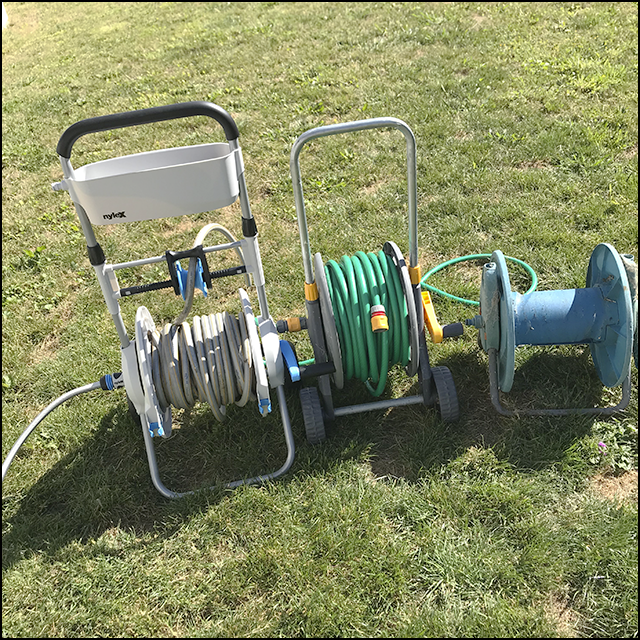
The third reel (the one with no handle) got an entirely new life: I use it too store an absurdly long string of Christmas tree lights—which I haven’t used for two years (last year I put up my old, small tree, and this past year I put up nothing because I was having work done in the house in mid-December, and I ran out of time.
This year is likely to be different yet again because of the exterior work I’m doing or having done. And, I may even put up my Christmas tree this year. Over the past five years I’ve done many different things, and worked on many different projects, and the storyline running through all of them is change: Making changes, changing my mind about the changes, or sometimes changing the changes after the fact. So, the story of the three hose reels and what have happened to them since I wrote about them five years ago is actually fairly typical of pretty much everything in my life. I don’t know whether that’s typical for everyone else, but that’s my reality—and I’m okay with that.
I know that there will be more changes this year, and every year I’m lucky enough to get—and I know most of them will be about more exciting things than hose reels. Whatever the new ones are about, they probably won’t be such odd examples of my constant change. I’m okay with that, too.
Thursday, January 08, 2026
Best laid plans. Again.
Not for the first time, my best laid plans have gone awry. I made plans, changed them, changed them again, and then ran into supply problems. And so, here I am.
Last Sunday, I talked about a project in by backyard to make a spot to put my Vegepod raised planter. I said that I decided to use grass instead of gravel, but that didn’t last. I changed my mind.
I had two issues. First, it would be at least a couple weeks before I could put the Vegepod on it, meaning I’d have to move it around a lot to keep it from sinking into the ground. Then, I looked at one of the company’s brochures and saw a photo of the grass option in use—and I hated it. It looked like an old-fashioned bumpy chenille bedspread, which would be okay for a parking area, but this would be roughly one square metre out of the entire lawn, and I felt it would look weird. Also, I realised that have to move it every time I mowed the back lawn would be a pain, and when I eventually hire mowers to do the back lawn, they probably wouldn’t move the Vegepod out of the way. None of that was ideal.
So, I went back to using gravel, and I studied up on what materials I needed to get, and today I finally had a chance to go to Bunnings, which has a much better selection of base course and gravel—except this time they didn’t. Base course, and sand they had, but they didn’t have gravel of the right size—the stones were wither too small or too big.
I’m going to have to source gravel, probably from a landscaping supply company, so that whole project is back on pause. What I think I’m likely to do is source enough gravel to use at the two ends of the patio, too (so it all matches). It shouldn’t take long to find the gravel, but I don’t want to have to store what I’ll need for the patio project, and I can really install that until the patio roof cover. Still, I may figure out a way if the patio cover is delayed.
There was one other development: I thought I’d made a mistake in calculating what I needed. I knew the Vegepod is one square metre, but a couple days after my Sunday post I realised that the two black plastic panels I bought were less one square metre, and because of the way they link to each other, I’d have to buy two more.
But then I thought, “hang on a minute…” and I grabbed a tape measure and went out to measure the stand it’s on, and that is 780mm by 780mm, which is, of course, smaller than one square metre, and it would fit on the two black plastic thingees I have (the Vegepod itself tapers down to its stand). Crisis averted! But I came to close to buying two more black thingees I didn’t need.
It’s not uncommon for me to revise plans for projects several times before I do them, and I’m also delayed by trying to figure out how to do one or parts of a project. However, this particular project has had more than its share of disruptions in a short period.
This isn’t a big deal. I have lots of other projects to work on, and most of them will be much easier.
Last Sunday, I talked about a project in by backyard to make a spot to put my Vegepod raised planter. I said that I decided to use grass instead of gravel, but that didn’t last. I changed my mind.
I had two issues. First, it would be at least a couple weeks before I could put the Vegepod on it, meaning I’d have to move it around a lot to keep it from sinking into the ground. Then, I looked at one of the company’s brochures and saw a photo of the grass option in use—and I hated it. It looked like an old-fashioned bumpy chenille bedspread, which would be okay for a parking area, but this would be roughly one square metre out of the entire lawn, and I felt it would look weird. Also, I realised that have to move it every time I mowed the back lawn would be a pain, and when I eventually hire mowers to do the back lawn, they probably wouldn’t move the Vegepod out of the way. None of that was ideal.
So, I went back to using gravel, and I studied up on what materials I needed to get, and today I finally had a chance to go to Bunnings, which has a much better selection of base course and gravel—except this time they didn’t. Base course, and sand they had, but they didn’t have gravel of the right size—the stones were wither too small or too big.
I’m going to have to source gravel, probably from a landscaping supply company, so that whole project is back on pause. What I think I’m likely to do is source enough gravel to use at the two ends of the patio, too (so it all matches). It shouldn’t take long to find the gravel, but I don’t want to have to store what I’ll need for the patio project, and I can really install that until the patio roof cover. Still, I may figure out a way if the patio cover is delayed.
There was one other development: I thought I’d made a mistake in calculating what I needed. I knew the Vegepod is one square metre, but a couple days after my Sunday post I realised that the two black plastic panels I bought were less one square metre, and because of the way they link to each other, I’d have to buy two more.
But then I thought, “hang on a minute…” and I grabbed a tape measure and went out to measure the stand it’s on, and that is 780mm by 780mm, which is, of course, smaller than one square metre, and it would fit on the two black plastic thingees I have (the Vegepod itself tapers down to its stand). Crisis averted! But I came to close to buying two more black thingees I didn’t need.
It’s not uncommon for me to revise plans for projects several times before I do them, and I’m also delayed by trying to figure out how to do one or parts of a project. However, this particular project has had more than its share of disruptions in a short period.
This isn’t a big deal. I have lots of other projects to work on, and most of them will be much easier.
Tuesday, January 06, 2026
Walking into my future

Before I started walking daily, I wasn’t sure how I was going to approach the challenge, and originally thought I might alternate days with longer walks with days of shorter walks. Then, I thought maybe I’d do two walks a day a couple times a week. However, I had trouble getting the spreadsheet to calculate averages, so I pretty quickly settled on one walk per day (the spreadsheet issue is probably user error—I’m no expert user—but the spreadsheet progreamme I use, part of the open source LibreOffice, is sometimes, um, quirky).
My original and mostly informal goal was to walk for 15 minutes or one kilometre, whichever came first. My idea was that if there was a day in which I just wasn’t feeling it, I could say, “I only have to do this for five more minutes,” or “Hm, 13 minutes? I can go a couple more minutes.” I knew that those little games would be enough to help keep me going longer, and that’s mostly what’s happened.
I walked every day, even on days when I wasn’t feeling well, except for one day when I felt particularly unwell. A couple days later, when I felt better, I did two walks, mostly so I could still have seven walks in the week and get the badge the Fitness App gives me when I do. The other days when I walked despite not feeling well had short walks, half a kilometre are most.
Part way through the year I started counting my mowing as a walk—because that’s what it is, something I only realised that when I started recording walking workouts. It is at a slower pace, though.
Speaking of pace, when I began it often took me around 15 minutes to cover a kilometre (which is why I came up with that as an original goal). Speaking of pace, at the start of the year my pace averaged out around 13 minutes per kilometre, and by the end of the year it was around 11 minutes per kilometre—though speed was never a goal, consistency was.
Overall, the results I noticed early on have continued. Most obvious to me, my legs definitely feel stronger, and I can notice theyre firmer—not visibly, they just feel more toned. My flexibility is better, and so, my balance is also better than when I started. One example of all three: I can now stand on one leg without wobbling uncontrollably—not that I ever actually need to do that, but still!
However, my stamina has not improved, apart from being able to walk farther and longer than before this started. I’d hoped that the walking might help with my general stamina, though that was a hope, not a goal. Maybe that will improve this year?
In 2026, I’ll be increasing the work. For one thing, I’ll start doing two walks per day, both an average of at least one kilometre, though I think that of the two, the morning walk may end up being the longer one of the two. There’s growing evidence that multiple short walks per day are more beneficial than one long one, though doing three walks is simply too big of an ask right now. I also plan on using my dumbbells more frequently, though I have no idea how often that’ll end up being. That’ll be a tale for next year’s post about all this.
In 2025, I walked a total of 427.67 kilometres (which is 265.741818 US miles). The map up top is lighthearted way to show how far that distance is (SOURCE). I think it’s funny that the distance shows I could walk to anywhere in the North Island, and even to the top of the South Island—assuming I really could literally walk on water, and not merely in people’s imaginations. Also, it would only take me a year to get there walking maybe 15 to 30 minutes a day…
Finally, although today is the anniversary of when I began this journey, I’m now only talking about stats for a calendar year, mainly because it’s easier for me (that pesky spreadsheet again). So, the stats I talk about here are for January 6 to December 31, 2025—though I’ve been walking and recording the results every day so far this year, of course. Right now, I think it’s time for a walk.
Previously:
“I’m going to live” – February 23, 2025
“I’ve been walking, yes indeed” – March 1, 2025
“Walking to… somewhere” – July 7, 2025
Sunday, January 04, 2026
Projectile living
The weather has been unfortunate this summer. Because of that, I’ve talked twice recently about how my outside projects were delayed. That weather is now on its summer break, and so, I’m not” We’re supposed to have days of sunny weather this week, so that (should) mean my projects will be back on track.
Tomorrow will the day most New Zealanders return to work after the two-week holiday period/ So, tomorrow is the first day I could recieve a call to schedule the installation of the roof over the patio. I’m not expecting that, but wouldn’t be surprised, either, but I’m not really expecting the installation until mid-January.
The only thing that really matters about the installation is that I have things that I must do before that, namely, I have to clear the stuff off the patio, and even a couple days notice will be enough for that. However, there’s one related project that will take extra time Preparing the new/old spot for the Vegepod raised garden. But I now what I’m going to do.
A little more than three years ago, I moved the Vegepod onto the patio because it was sinking into the grass. Sinking aside, that was a good spot: It’s warm, gets full afternoon sun, and as late as possible in summer, and it’s conveniently close to the patio doors so I can collect fresh herbs or whatever. Yeah, but that sinking, though.
My first plan was to put down pavers, something I’ve never done, but I was keen to have a go. Somewhere along the thinking process, I suddenly remembered what I’d planned to do at one point to create a place to store my rubbish and recycling wheelie bins, and that’s what I settled on doing under the Vegepod.
 I’ll use a product called “SurePave” by a company called Strol (see the photo at right—and this is NOT an ad—I bought all my supplies at normal retail prices). The product is manufactured in Thames (not far from where Nigel and I lived 20 years ago), and is made of recycled plastic and is also recylable. It’s used to create a stable suirface to walk on or, in the case of the “heavy duty” version I picked, park on. The voids in the “honeycomb” can be filled with gravel or dirt with grass growing in the voids (there are several ways of doing that, and it’s sometimes called “grass paving” because when it blends in with lawns, but it’s also dytong enough to park on.
I was originally going to fill the voids with gravel, but just today I decided to use grass instead. That’s because I’m going to use gravel at the ends of the patio, and I felt that the grass paving under the Vegepod would be more subtle. The downside is that I'll have to pull the Vegepod off to mow underneath it, just as I did when it lived there before.
The reason I decided on the SurePave system was because it’s permeable—water can soak into the ground. If I’d gone with pavers, as I originally planned, it would’ve been impermeable and water would have to run onto the lawn to soak in—somewhere. With more rain and storms due to climate change, it made sense to me that I should make it easy for rain water to soak into the ground like normal.
Work on the new parking spot for the Vegepod starts this week, but I doubt it’ll be ready until after the patio roof is installed, because the grass will need time to grow before I park it there. As long as I move the Vegepod around until the new spot is ready, it should be fine, with no sinking into the ground. If all else fails, I can park it on the patio if (when?) we get another extended rainy period.
And that’s the first project to get ready for the patio renovation project. I’ll have photos to share, of course, but right now I’m just glad the weather is finally cooperating.
Tomorrow will the day most New Zealanders return to work after the two-week holiday period/ So, tomorrow is the first day I could recieve a call to schedule the installation of the roof over the patio. I’m not expecting that, but wouldn’t be surprised, either, but I’m not really expecting the installation until mid-January.
The only thing that really matters about the installation is that I have things that I must do before that, namely, I have to clear the stuff off the patio, and even a couple days notice will be enough for that. However, there’s one related project that will take extra time Preparing the new/old spot for the Vegepod raised garden. But I now what I’m going to do.
A little more than three years ago, I moved the Vegepod onto the patio because it was sinking into the grass. Sinking aside, that was a good spot: It’s warm, gets full afternoon sun, and as late as possible in summer, and it’s conveniently close to the patio doors so I can collect fresh herbs or whatever. Yeah, but that sinking, though.
My first plan was to put down pavers, something I’ve never done, but I was keen to have a go. Somewhere along the thinking process, I suddenly remembered what I’d planned to do at one point to create a place to store my rubbish and recycling wheelie bins, and that’s what I settled on doing under the Vegepod.

I was originally going to fill the voids with gravel, but just today I decided to use grass instead. That’s because I’m going to use gravel at the ends of the patio, and I felt that the grass paving under the Vegepod would be more subtle. The downside is that I'll have to pull the Vegepod off to mow underneath it, just as I did when it lived there before.
The reason I decided on the SurePave system was because it’s permeable—water can soak into the ground. If I’d gone with pavers, as I originally planned, it would’ve been impermeable and water would have to run onto the lawn to soak in—somewhere. With more rain and storms due to climate change, it made sense to me that I should make it easy for rain water to soak into the ground like normal.
Work on the new parking spot for the Vegepod starts this week, but I doubt it’ll be ready until after the patio roof is installed, because the grass will need time to grow before I park it there. As long as I move the Vegepod around until the new spot is ready, it should be fine, with no sinking into the ground. If all else fails, I can park it on the patio if (when?) we get another extended rainy period.
And that’s the first project to get ready for the patio renovation project. I’ll have photos to share, of course, but right now I’m just glad the weather is finally cooperating.
Saturday, January 03, 2026
As for example

The photo up top is of my weedy back lawn yesterday afternoon. It had become about as overgrown as around a month ago (“almost” because it was three weeks between mows, not four), and this happened because of the reason I talked about last Tuesday: Rain—lost and lots of rain. The only days it didn’t rain were days I wasn’t able to do the mowing. As it happens, I was planning on visiting my mother-in-law yesterday, but when the sunny weather wasn’t going away, so I decided to do the mowing first.
When I got to my mother-in-law’s place, were laughing about not being able to remember what day it was, something I mentioned in a more serious context yesterday. After I left from my visit, I headed to one the home centres, Mitre 10 Mega, to pick up some suplies the other one (Bunnings Warehouse) doesn’t carry. I didn’t know what traffic would be like, much as I talked about on m post about Boxing Day. But wait, there’s more!
When I went to Bunnings on December 27, it was technically an ordinary Saturday, so I knew the hours would be the same. But yesterday, January 2, was a public holiday, and I realised I had no idea what the opening hours were for Mitre 10 or the supermarket I was going to afterward. I looked them up online before I left my mother-in-law’s place—and had some trouble finding the answer. Mitre 10 seemed to be their normal 7pm, but the supermarket closing was 7pm, a couple hours earlier than normal.
I got to Mire 10 around 5 to 6, picked up the first thing on my list, and then a minute later an announcement came over the P.A. that they were closing in four minutes. Fortunately, I’d looked up the aisle and bay that other items were in, and just skipped over what I hadn’t written down, and headed to the checkout, feeling a kind of disappointed frustration (though, to be clear, I still like the store: It’s NZ-owned and closer to my house than Bunnings is, but Bunnings has greater depth in some specifically hardware things, which I won’t go into right now. You’re welcome).
When I got to the supermarket, they had a sign with all their holiday hours for past two weeks, and it was, in fact, 8pm, so I could take me time shopping. I was back home before 6pm.
And speaking of rain, it was still sunny when I got home last night, but the clouds moved in and around 8:30 I heard some of the expected thunder, accompanied with heavy rain. Around midnight, the rain became extrelemy heavy and there was louder thunder. All of which was over in around an hour or so. Today started out sunny again, then yet more rain, and then thunder, returned early afternoon.
Rain has clearly been the number one topic over the past month or so in particular. I thought it was interesting how just one day had so much of what I talked about over the past week or so. But the holidays are over for now (the next one, Auckland Anniversary Day, is Monday, January 27), so it’ll mostly be mostly ordinary days. And mostly rainy, too, apparently. Oh, well.
Friday, January 02, 2026
Forgetting the weekday because of a good focus
This is the time of year when I can’t remember what day of the week it is. That’ll happen when there are two weeks in a row that each have two public holidays. This speaks volumes about how different life in New Zealand is from life in the land of my birth, but many countries have it far better than folks in the USA have it. It doesn’t have to be that way for the US, and some want to take it away from New Zealanders—though, yeah, nah, that’s not going to happen.
Christmas Day and Boxing Day (December 25 and 26) are both public holidays, and the following week January 1 and 2 are also both public holidays. There’s also a “trading ban” on Christmas Day, which, despite werdly complicated rules and exceptions, generally means most businesses must close on that day. The other three are ordinary public holidays, but in New Zealand that actually means something.
Public holidays are sometimes called “statutory holidays” (or “stat day” for short) because they’re specifically named in law and have specific regulations. For example, most full-time workers who are required to work on a public holiday will receive 1.5 times their normal hourly pay, and they’ll be entitled to another day off in lieu (as it’s called) at a time the worker and employer agree to. In reality, it’s a bit more complicated than that, with some variations because of a worker’s specific circumstances, however, that’s the gist of it.
Another important thing for workers about the public holidays for Christmas Day and Boxing Day and January 1 and 2 is that if one or both days fall on a weekend, the public holidays are observed on the following Monday, or Monday and Tuesday if both fall on a weekend. For example, in 2026 Christmas Day falls on a Friday, and Boxing Day on Saturday, so the Boxing Day public holiday for workers will be on Monday, December 28.
This same thing repeats the following week for 2027 New Year’s Day and the day after. So, most Kiwis get two four-day weekends in a row—not every year, but many years—which is supremely awesome, and it allows many folks to have a two week break from work while only using maybe six annual leave days (“vacation days” in Americanese) instead of ten. Full-time workers in New Zealand are generally entitled to 20 annual leave days per year, plus 12 paid days off for public holidays.
I mention all that, even though I have several times before, because it make a very important point: Workers’ rights to things like paid time off don’t have to rely on the graciousness or mercy of employers, and that governments can, and most do, enforce workers’ rights. American workers aren’t treated poorly compared to workers in most OECD countries because “it’s just the way it is” or because “government can’t change things”, but, rather, it’s because of weak or compromised politicians who refuse to do the right thing for working people, and instead do only the absolute bare minimum that won’t upset big corporations and oligarchs too much. They do only enough to prevent working people from using the power in their numbers to force change by electing politicians who are on the side of working people, and not consumed by doing the bidding of corporations and oligarchs.
Most politicians in US state and federal governments rely on campaign donations from corporations and oligarchs, directly or indirectly, and so, they vote to advance the interests of their financial benefactors and not the needs of ordinary working people. It’s said that “the love of money is the root of all evil”, but campaign contributions from corporations and the rich are particularly rich fertiliser for those roots, and the rotten fruit that grows is merely the logical result.
Money weakens democracy in nearly every country, and the love of money is certainly at the core of many Rightwing parties throughout the OECD, and that includes New Zealand. When conservatives are in power, we see attempts to restrict workers’ rights and to enrich corporations. But the centrist parties don’t push hard enough to do what ordinary working people want and need.
Most politicians spend most of their time telling ordinary citizens what they “can’t” have. What those things are will vary from place to place, but the tendency is pretty much universal. Politicians on both the Right and the Left do this, but there are difference: To the Right, nothing the people want is possible, but what corporations and oligarchs want always is. Centrist politicians do some things to help some ordinary people, but their difference from the Right is mainly one of degree, and perhaps a bit more humanity. Maybe this will soon change.
The mission of politicians—the people’s representatives—is to do one thing: Deliver what the people want. If something is difficult to achieve, then it’s their job to work how to deliver what the people want, and if there really are genuine trade-offs, then they must be open and honest with the people so they can weigh in on what should be priorities and what really can be deferred. In other words, politicians must do the work their bosses—voters—elected them to do. If they can’t or won’t to what voters want, they need to get out of the way.
I’ve seen signs that things are beginning to change in some countries, and that people are beginning to demand that their elected representatives do what the people want. This is the possible antidote to many governments sole focus on the needs of corporations and oligarchs. Ordinary people far outnumber the oligarchs, and only destruction of democracy can slow this gradual march toward more just societies—which means, it’s still possible for the oligarchs to kill off the infant people’s movement.
In the meantime, people like me who live in countries that respect workers will continue to sometimes get confused this time of year about what day of the week it is because of the time off that workers get at this time of year. But countries like the USA can still catch up. It’s time they did.
Christmas Day and Boxing Day (December 25 and 26) are both public holidays, and the following week January 1 and 2 are also both public holidays. There’s also a “trading ban” on Christmas Day, which, despite werdly complicated rules and exceptions, generally means most businesses must close on that day. The other three are ordinary public holidays, but in New Zealand that actually means something.
Public holidays are sometimes called “statutory holidays” (or “stat day” for short) because they’re specifically named in law and have specific regulations. For example, most full-time workers who are required to work on a public holiday will receive 1.5 times their normal hourly pay, and they’ll be entitled to another day off in lieu (as it’s called) at a time the worker and employer agree to. In reality, it’s a bit more complicated than that, with some variations because of a worker’s specific circumstances, however, that’s the gist of it.
Another important thing for workers about the public holidays for Christmas Day and Boxing Day and January 1 and 2 is that if one or both days fall on a weekend, the public holidays are observed on the following Monday, or Monday and Tuesday if both fall on a weekend. For example, in 2026 Christmas Day falls on a Friday, and Boxing Day on Saturday, so the Boxing Day public holiday for workers will be on Monday, December 28.
This same thing repeats the following week for 2027 New Year’s Day and the day after. So, most Kiwis get two four-day weekends in a row—not every year, but many years—which is supremely awesome, and it allows many folks to have a two week break from work while only using maybe six annual leave days (“vacation days” in Americanese) instead of ten. Full-time workers in New Zealand are generally entitled to 20 annual leave days per year, plus 12 paid days off for public holidays.
I mention all that, even though I have several times before, because it make a very important point: Workers’ rights to things like paid time off don’t have to rely on the graciousness or mercy of employers, and that governments can, and most do, enforce workers’ rights. American workers aren’t treated poorly compared to workers in most OECD countries because “it’s just the way it is” or because “government can’t change things”, but, rather, it’s because of weak or compromised politicians who refuse to do the right thing for working people, and instead do only the absolute bare minimum that won’t upset big corporations and oligarchs too much. They do only enough to prevent working people from using the power in their numbers to force change by electing politicians who are on the side of working people, and not consumed by doing the bidding of corporations and oligarchs.
Most politicians in US state and federal governments rely on campaign donations from corporations and oligarchs, directly or indirectly, and so, they vote to advance the interests of their financial benefactors and not the needs of ordinary working people. It’s said that “the love of money is the root of all evil”, but campaign contributions from corporations and the rich are particularly rich fertiliser for those roots, and the rotten fruit that grows is merely the logical result.
Money weakens democracy in nearly every country, and the love of money is certainly at the core of many Rightwing parties throughout the OECD, and that includes New Zealand. When conservatives are in power, we see attempts to restrict workers’ rights and to enrich corporations. But the centrist parties don’t push hard enough to do what ordinary working people want and need.
Most politicians spend most of their time telling ordinary citizens what they “can’t” have. What those things are will vary from place to place, but the tendency is pretty much universal. Politicians on both the Right and the Left do this, but there are difference: To the Right, nothing the people want is possible, but what corporations and oligarchs want always is. Centrist politicians do some things to help some ordinary people, but their difference from the Right is mainly one of degree, and perhaps a bit more humanity. Maybe this will soon change.
The mission of politicians—the people’s representatives—is to do one thing: Deliver what the people want. If something is difficult to achieve, then it’s their job to work how to deliver what the people want, and if there really are genuine trade-offs, then they must be open and honest with the people so they can weigh in on what should be priorities and what really can be deferred. In other words, politicians must do the work their bosses—voters—elected them to do. If they can’t or won’t to what voters want, they need to get out of the way.
I’ve seen signs that things are beginning to change in some countries, and that people are beginning to demand that their elected representatives do what the people want. This is the possible antidote to many governments sole focus on the needs of corporations and oligarchs. Ordinary people far outnumber the oligarchs, and only destruction of democracy can slow this gradual march toward more just societies—which means, it’s still possible for the oligarchs to kill off the infant people’s movement.
In the meantime, people like me who live in countries that respect workers will continue to sometimes get confused this time of year about what day of the week it is because of the time off that workers get at this time of year. But countries like the USA can still catch up. It’s time they did.
Thursday, January 01, 2026
Another New Year has begun

I went out for pizza with my brother-in-law and his partner, and even had a glass of whine, since I wasn’t driving. I was home by early evening, and carried on with my typical New Year’s Eve.
I’ve mentioned several times that I’ve almost always been the only one in my household to stay up to midnight on New Year’s Eve, and that it’s something I’ve done for many, many decades. Nigel almost never stayed up to midnight, but when it arrived he’d call out to me to come so we could share our first kiss of the New Year, mainly because he knew it was important to me.
I found that memory painful for the first few years after Nigel died, and while I still think of it every year, it’s not the source of pain that it once was. Memories like that can evolve alongside us, eventually becoming warm and fuzzy again.
I saw in the New Year, but I was watching the countdown and Auckland fireworks on TVNZ+, their streaming service, becauce the bad weather was causing disruption in the UHF signal. That was fine, but I knew the stream is delayed by around ten seconds, so I was using my iPad to watch the actual time so that I knew when 2026 actually arrived, said “Happy New Year!” to no one in particular, though Leo looked over at me, so I wished him a happy new year—not that he seemed to get what that meant. A few seconds later, I saw the countdown and fireworks on my TV as I took the selfie up top, my first photo of the year. Delayed or not, I was just glad that TVNZ did that that again this year, because there have been years when they did nothing at all.
After the fireworks (a five minute broadcast), I went back to watching TV, fell asleep in my chair for awhile, and headed off to bed. And that was my start to 2026.
2025 was, as I expected, my worst-ever full year of blogging. Part of that is because there were a lot of posts I never got around to last year. I still want to get to those, and, of course, I have all my projects that will be ending this year, so there will be a lot to talk about this year. I don’t make New Year’s Resolutions, as I’ve explained several times, but I do have have annual goals, and this year that includes doing more blog posts. To be clear, I doubt there’ll be a return to my old one-post-a-day average, but I have a goal of an average of one every other day—roughly 15.21 posts per month. I think that’s a reasonable goal—I’ve done more than that every full year except for 2022, 2024, and, of course, 2025. We’ll see.
New Year provides an opportunity for a reset. Whether that happens or not will be the overall story of 2026. I’m really interested to see what happens.
Subscribe to:
Comments (Atom)